AI vs. Manual Product Photo Editing: Which Is Best for Your eCommerce Business?
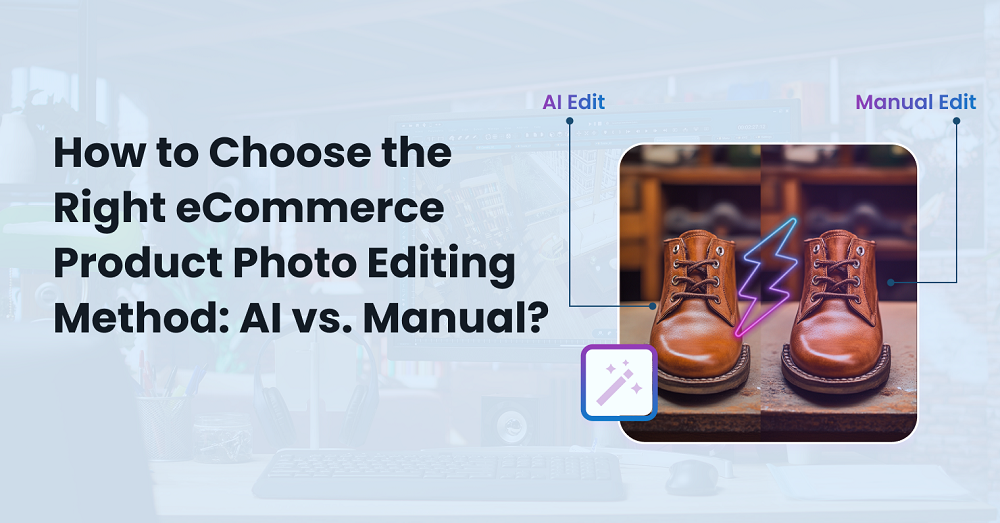
What improves eCommerce product listings more: AI photo editing, manual retouching, or a combination of both?
For most eCommerce businesses, the answer depends on what they are optimizing for: speed, image accuracy, brand consistency, or cost control. AI editing helps process large image volumes quickly and supports catalog-wide standardization. Manual editing offers tighter control over product detail, visual refinement, and brand-specific presentation. A hybrid workflow brings both together, using automation for repetitive production tasks and expert review where image quality, realism, or merchandising precision matter more.
This blog breaks down the strengths and limitations of AI and manual photo editing approaches, an assessment framework for brands to choose the best method, best practices for editing, and how eCommerce product photo editing services help. Let’s begin!
Table of Content
- AI in eCommerce Product Photo Editing
- Assessment Framework: How to Choose the Right eCommerce Product Photo Editing Method for Your Business?
- Best Practices for eCommerce Product Image Editing
AI in eCommerce Product Photo Editing
AI-driven tools have transformed how businesses approach product photo editing. By leveraging machine learning algorithms, these tools can automate several repetitive tasks, such as background removal, color correction, resizing, and object detection. With their ability to handle large volumes of images quickly and efficiently, AI tools are particularly advantageous for businesses with extensive product catalogs.
Advantages:
- Speed and Scalability: AI tools can process thousands of images in a fraction of the time it takes for human editors, making them ideal for businesses with large catalogs.
- Consistency: AI tools provide uniformity across product photos, ensuring a consistent look and feel across all images—important for maintaining a cohesive brand image.
- Cost-Efficiency: For businesses on a budget, AI offers an affordable alternative to manual editing, as it requires minimal human input once the tool is set up.
Limitations:
- Lack of Creative Control: AI tools excel at repetitive tasks but lack the creativity and nuanced decision-making that manual editing provides. For high-end or complex products, human touch may be necessary.
- Challenges with Complex Images: AI may struggle with images that have intricate details, such as multiple reflections or irregular shapes. In these cases, manual editing may be needed to ensure a polished result.
Manual Photo Editing: Precision and Customization
Manual editing, using software like Adobe Photoshop or Lightroom, offers a higher degree of creative control and customization. This method allows professional editors to fine-tune every aspect of a product image, from lighting and shadows to texture and contrast, ensuring that the image accurately represents the product.
Advantages:
- Creative Flexibility: Manual editing gives full control over the image, allowing editors to make specific adjustments to enhance visual appeal. This is especially important for premium brands or products requiring artistic representation.
- Customization for Complex Products: For products with intricate details, manual editing ensures that every aspect is captured precisely, whether it’s jewelry, electronics, or other high-value items.
- Brand Identity: Manual editing allows for tailored adjustments to meet specific brand aesthetics, which AI tools may struggle to replicate.
Limitations:
- Time-Consuming: Manual editing requires a significant amount of time, particularly when dealing with large quantities of product images. Each image must be individually processed, which can delay turnaround times.
- Higher Costs: Professional editors charge for their time, making manual editing more expensive than AI solutions. This cost can quickly add up for businesses with large product inventories.
- Inconsistencies: Different editors may apply varying techniques and styles, which can result in inconsistencies across images unless a rigorous process is in place.
A Hybrid Approach: Combining the Strengths of AI and Manual Editing
While AI and manual editing each have their advantages, the most effective approach for most businesses is a hybrid one. By combining AI-driven automation with the expertise of human editors, businesses can optimize product listings without compromising on quality.
In a hybrid approach:
- AI tools can handle repetitive, time-consuming tasks such as background removal, color correction, and image resizing, speeding up the overall editing process.
- Manual editing can focus on refining complex images or adjusting the finer details to ensure that the final product images align with the brand’s vision and meet the quality standards required for high-end products.
Assessment Framework: How to Choose the Right eCommerce Product Photo Editing Method for Your Business?
| Criteria | Manual Editing | AI Editing | Hybrid Approach |
|---|---|---|---|
| Product Type | Best for high-end, intricate items where detail and craftsmanship are paramount (e.g., jewelry, luxury fashion). | Ideal for straightforward, low-variance products where speed and consistency are prioritized (e.g., electronics, packaged goods). | —– |
| Volume of Images | Best for smaller catalogs with premium products requiring custom edits for each item. | Ideal for large catalogs where standardization is key—background removal, resizing, and basic cleanup are handled automatically. | Ideal for high-volume businesses that need speed but cannot afford to compromise on the quality of key images. |
| Complexity of Product Images | Required for products with intricate details (e.g., reflective surfaces, fine textures) where precision is critical. | Suitable for simple products with minimal detail or clear, high-contrast subjects that don’t need much adjustment. | Combines AI’s ability to streamline basic edits (background removal, cropping) with human expertise to preserve fine details, ensuring the product’s true nature is well represented. |
| Turnaround Time | Slower due to the intensive manual work required for adjustments, retouching, and creative input. | Faster for bulk tasks, reducing the time needed for tasks like background removal and resizing. | Achieves a balance—AI expedites routine edits, while experts ensure refinement, speeding up overall production without compromising quality. |
| Budget Considerations | More costly due to the time and expertise required for high-quality edits. | Cost-effective for large-scale edits, especially for standardized image adjustments. | Cost-effective for high-volume operations, as AI handles the bulk of repetitive tasks, while human expertise focuses on maintaining brand standards and optimizing key product images. |
| Usage of Image (Hero Image vs. Variant) | Best for hero images or main product shots where quality and detail are paramount to attracting customer attention. | Suitable for variant images, smaller views, or product shots that don’t require the highest level of detail. | ——– |
Best Practices for eCommerce Product Image Editing
1. Establish Clear Brand Guidelines
Define image standards for background, lighting, angles, cropping, shadows, and color to maintain consistency across listings and distribution channels.
2. Ensure Structured Quality Control
Implement structured QA checks at key stages to verify image accuracy, brand alignment, and marketplace compliance before final approval.
3. Maintain Security and Compliance Standards
Ensure the workflow follows defined security controls, role-based access, and applicable compliance requirements such as General Data Protection Regulation (GDPR), Health Insurance Portability and Accountability Act (HIPAA). Ensure the editing workflows adhere to security and quality standards, such as ISO/IEC 27001 and ISO 9001.
4. Monitor and Optimize Performance
Review workflow efficiency, rejection rates, return trends, and customer feedback regularly to improve image quality, process consistency, and listing performance.
Looking to Optimize Your Product Image Editing?
Let our experts combine AI efficiency and manual precision to enhance your product listings, ensuring quality, consistency, and faster turnaround.
| Request a Free Trial! | Share Project Requirements! |